
close
Choose Your Site
Global
Social Media

Views: 0 Author: Site Editor Publish Time: 2026-11-10 Origin: Site


A suitable KURZ hot stamping foil alternative must match the original material's application requirements, not just its color. Buyers should compare substrate compatibility, transfer quality, appearance, and durability before switching.
This guide explains how to evaluate replacement foils and reduce production risks.
Table of Contents
KURZ is an established name in decorative transfer technology. Its foils are used across different industrial and graphic applications.
However, manufacturers may seek additional suppliers for several reasons.
Depending on a single supplier can create purchasing risks.
An alternative supplier may help buyers manage supply interruptions and changing production schedules.
Qualified secondary suppliers can also provide greater flexibility for future orders.
Manufacturers often compare purchasing terms, delivery schedules, and material costs.
However, lower foil prices do not always reduce overall production costs.
Poor transfer efficiency, increased waste, and additional machine adjustments can offset initial savings.
Some manufacturers need special colors, custom roll dimensions, or different substrate compatibility.
A supplier may offer a candidate material that fits those requirements.
The candidate must still be validated before production use.
Before requesting samples, identify the critical properties of the existing material.
Record the complete product name and manufacturer reference.
For example, a buyer may need a substitute for KURZ CHROM EXT. GLC 73725/05 (REAL CHROME).
This is a specific reference for a chrome-effect decorative application. It should not be treated as interchangeable with a generic silver stamping foil.
The exact product specification, current availability, and required qualification should be confirmed using the buyer's existing technical documentation.
Foils are designed for different application surfaces.
Common substrates include:
Paper and paperboard.
Laminated printing sheets.
ABS plastic components.
PVC and other compatible plastics.
Coated or treated surfaces.
An alternative that performs well on paper may not adhere properly to molded ABS.
For plastic applications, the specific material grade and surface treatment matter.
The candidate foil should be evaluated using the existing production process.
Important conditions include die temperature, applied pressure, dwell time, machine type, and working speed.
Some materials may require process adjustments.
A suitable replacement should operate within a practical production window without damaging the substrate.

Color matching is especially important for decorative components.
Two foils may look nearly identical on a sample card.
However, their appearance can change after transfer onto a plastic component.
The final result depends on the reflective layer, surface coating, substrate smoothness, and processing conditions.
For high-gloss chrome applications, visual comparison should include:
Metallic brightness.
Mirror-like reflectivity.
Color consistency.
Surface clarity.
Uniformity across large areas.
Edge definition around detailed patterns.
Use the approved original foil as a control sample.
Stamp the original and alternative materials onto the same substrate, using documented processing conditions.
Compare their appearance under consistent lighting.
When possible, measure color and gloss using suitable instruments.
A visually acceptable alternative must still pass the required adhesion and durability tests.
A structured comparison makes supplier evaluation more reliable.
Evaluation Factor | What Buyers Should Check | Why It Matters |
|---|---|---|
Color and finish | Reference sample appearance | Visual consistency |
Substrate compatibility | Actual plastic or laminated surface | Adhesion performance |
Foil release | Complete transfer and clean edges | Production quality |
Temperature range | Stable performance within equipment limits | Process compatibility |
Durability | Required environmental testing | Service performance |
Roll dimensions | Width, length, core, winding | Machine compatibility |
Batch consistency | Repeatability between supplied rolls | Production stability |
Purchasing terms | MOQ, lead time, and pricing | Supply planning |
The most suitable alternative is not necessarily the one with the closest appearance alone.
It is the material that meets all essential requirements under controlled production conditions.
A sample evaluation should be completed before placing a production order.
Collect the original foil reference, substrate details, application photographs, and available technical specifications.
If possible, provide a sample of the current foil and a finished component.
Avoid relying only on generic supplier sample cards.
Use the same substrate type that will be used in production.
For molded parts, the sample should reflect the actual resin grade, surface finish, and processing history.
Check transfer completeness, release behavior, edge sharpness, and metallic finish.
Record the machine settings used for each test.
An alternative may require minor adjustments, but the results should remain repeatable.
For automotive exterior parts, possible requirements include adhesion, thermal cycling, humidity, chemical exposure, and accelerated weathering.
ISO 4892-2 describes xenon-arc exposure methods for plastics, which may form part of a defined weathering program.
The applicable test procedures and acceptance criteria must come from the customer's specification.
For additional automotive material considerations, read our guide to automotive hot stamping foil for ABS parts.
After the initial sample passes, evaluate the material in a representative production run.
Confirm whether the same appearance and transfer performance can be maintained across multiple parts.
The buyer should approve the replacement before regular production begins.
The supplier should understand your existing application rather than recommend a generic color match.
A useful inquiry should contain:
Current brand and foil reference.
Target color or chrome finish.
Substrate material and surface treatment.
Product application and exposure environment.
Stamping equipment and process conditions.
Required roll width, length, and core diameter.
Expected order quantity.
Required testing standards.
Ask for sample availability before making a purchasing decision.
Pricing and minimum order quantity may vary by foil grade, color, width, and production volume.
Custom dimensions should also be confirmed.
Technical evaluation should come before commercial approval when the replacement is used in a demanding application.
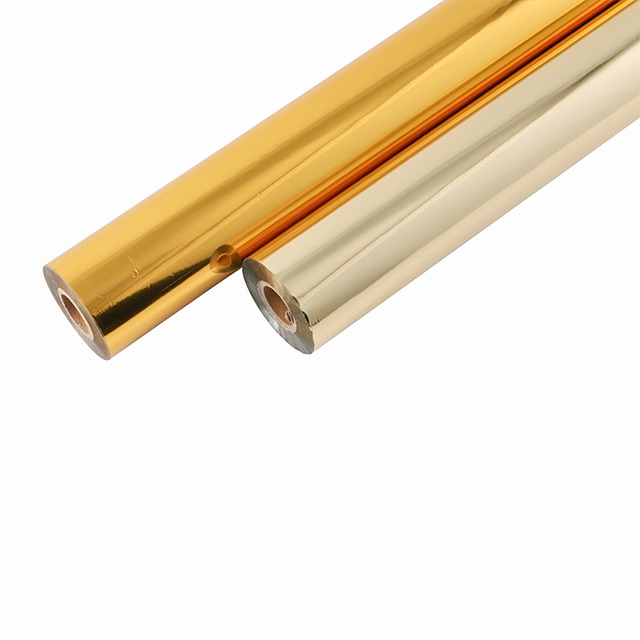
HUASHENG manufactures decorative hot stamping foils for printing, packaging, and selected plastic substrates.
Its AED hot stamping foil series is listed for applications involving ABS, PP, PVC, and PET.
HUASHENG also supplies AEP hot stamping foil for paper and laminated surfaces.
These product ranges can be considered when discussing alternative sourcing options.
However, HUASHENG's published product information does not establish direct equivalence to KURZ GLC 73725/05 or approval for exterior automotive use.
Any proposed replacement requires confirmation through technical review and customer testing.
For laminated printing applications, explore our hot stamping foil for matte and gloss laminated paper guide.
Potentially. The alternative must meet the original material's essential appearance, processing, and performance requirements.
Not necessarily. Reflectivity, coating structure, adhesion, and durability may differ significantly.
Some plastic-specific grades may work on ABS. Compatibility must be verified on the actual substrate.
Pricing depends on grade, color, dimensions, and quantity. Request a quotation using your complete specifications.
A successful KURZ hot stamping foil alternative must deliver consistent transfer, suitable appearance, and verified performance. Reference samples and controlled testing are essential, especially for demanding plastic applications.
HUASHENG offers hot stamping foils for different substrates and accepts inquiries for alternative material evaluation. Share your current foil grade, application, and technical requirements to discuss possible options.
Looking for an Alternative Hot Stamping Foil Supplier?
Send HUASHENG your existing foil reference, substrate information, required finish, and annual consumption. Request a technical review, sample availability, and quotation.
